Why are my outdoor LED lights flickering at night? The answer may be a failing driver, a loose connection, an incompatible dimmer, or voltage changes—not necessarily a bad LED. A brief pulse can appear when a motion sensor switches on, while steady flicker may point to a different fault. Look closely: does it happen during rain, when another appliance starts, or only at low brightness? Small details matter.
The U.S. Department of Energy’s report Flicker: Understanding the New IEEE Recommended Practice explains that changes in light output can vary in frequency and visibility. IEEE Recommended Practice 1789-2015 also evaluates LED flicker through modulation and frequency, rather than treating every flicker as identical. These references help frame the problem, but they cannot diagnose a particular porch light from a distance. Lighting researcher Naomi Miller’s published work offers a useful practical reminder, paraphrased here: “Check the complete lighting system, not only the LED lamp.” That means checking the driver, controls, wiring, and power supply together. Sometimes the first guess is wrong. A wet junction box or a dimmer mismatch can mimic a failing bulb. This guide explores common causes, simple observations, and when a qualified electrician should inspect the fixture. Start with what you can see—and don’t ignore a persistent flicker.
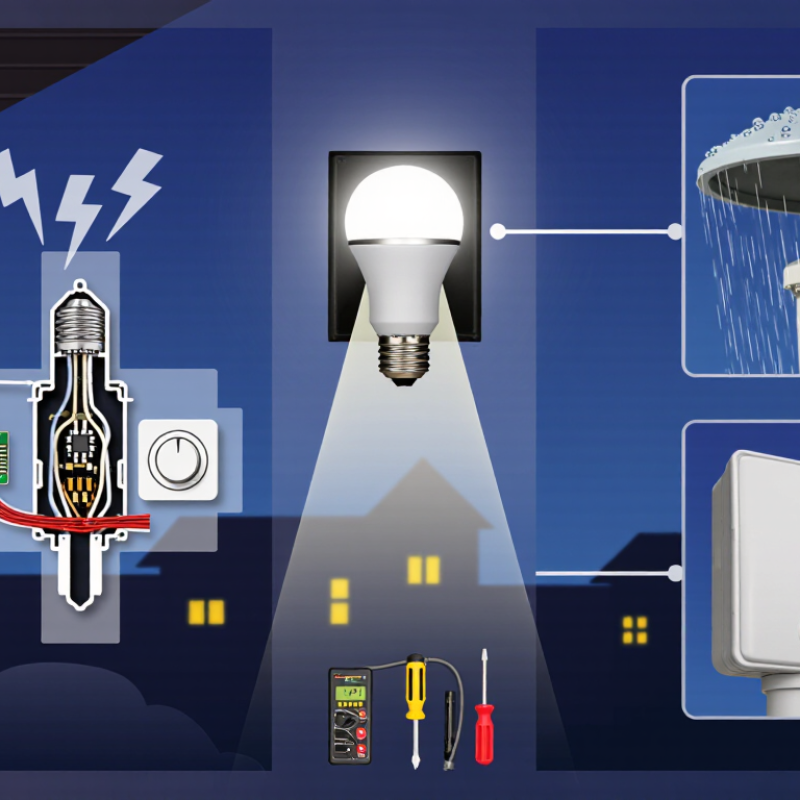
At night, outdoor LED flicker may look like a faint shimmer around a doorway, or a quick pulse across a driveway. Dark-adapted eyes notice small changes more readily, especially against a steady, dim background. Moving branches and passing cars can make the effect seem stronger. Sometimes it is barely visible until you look away. Flicker often comes from fluctuating power, an incompatible dimmer, or a driver struggling at low output.
A useful engineering reference is IEEE Std 1789-2015, which sets a low-risk benchmark below 8% light modulation at 100 Hz. This is guidance, not a guarantee that every person will find a lamp comfortable. The percentage describes how much the light output varies over time. A phone camera can reveal dark rolling bands, but its shutter settings may exaggerate or hide flicker. One clue can mislead. Check the fixture at full brightness and while dimmed, then compare it with another light on the same circuit.
Tips: Film the light in slow motion, then inspect it at several dimming levels. Note whether flicker starts after rain, near dusk, or when another device switches on. Those details help separate a control issue from unstable supply or a loose outdoor connection. Don’t assume the LED chip itself is faulty. A qualified electrician can check wiring and voltage safely.
China Best Outdoor LEDs Why Flicker at Night?
Electrical and Environmental Causes of Nighttime Flicker
Outdoor LED flicker often starts with an electrical mismatch. A loose connection, failing driver, or unstable supply can interrupt current and make lights pulse. Dimming controls may also conflict with an LED driver, even when the fixture seems to work at first. Flicker across several lights can point to a shared circuit issue. A single flickering fixture may have a local fault.
The night environment can add confusion. Moisture inside a fixture may affect contacts, while sharp temperature changes can stress a driver. Photocells may switch repeatedly if nearby lights shine onto the sensor or reflective surfaces send light back toward it. That cycling can look like a failing LED. A quick glance may not reveal the cause; I would not assume the bulb is always at fault.
Tips: Note whether one fixture or several flicker, and whether it happens during rain, cold snaps, or sensor activation. Check for visible damage only after switching off power. Do not open live wiring. If flicker persists, or connections appear loose, ask a qualified electrician to inspect the fixture, driver, and circuit.
Outdoor LED lights often flicker because their power supply, connections, or controls are unstable. Start by watching the fixture directly; phone cameras can show bands that are not visible to your eyes. Note when flickering begins, how long it lasts, and whether nearby lights behave the same way. A pattern helps narrow the cause.
If one light flickers, a failing LED driver, loose connection, or moisture inside the fixture may be responsible. If several lights pulse together, check for a shared dimmer, photocell, or supply issue. A photocell can cycle when nearby lighting shines onto its sensor. Flickering after rain deserves attention, especially if water droplets appear beneath the lens. Diagnosis is not always immediate; one clue rarely proves the cause.
Tips: Turn off power before inspecting a fixture, and never handle exposed wiring. Check that bulbs and dimmers are compatible, and look for cracked seals or corrosion from a safe position. If the flicker continues, the breaker trips, or you notice a burning smell, stop using the light and contact a qualified electrician. Don’t guess at live wiring.
| Observed Flicker Pattern | Likely Cause | How to Diagnose | Practical Next Step | Safety Note |
|---|---|---|---|---|
| Light turns on at dusk, then repeatedly switches off and on. | Photocell or dusk-to-dawn sensor is receiving stray light from the fixture or another nearby light. | Check whether the sensor faces the fixture, a reflective surface, or another light source. Observe whether cycling occurs around dusk or dawn. | Reposition or shade the sensor as permitted by its instructions. Replace a damaged sensor with a compatible outdoor-rated part. | Isolate power before adjusting or replacing wired components; follow the fixture and sensor instructions. |
| Flicker occurs only when the lamp is dimmed or at a low brightness setting. | Dimmer and LED driver are incompatible, or the dimmer's minimum-load range is not suitable for the LED load. | Check the fixture and dimmer documentation for compatibility. If safe, compare operation at full brightness with operation at a lower setting. | Use a dimmer specifically rated for the LED fixture and its driver, or have a qualified electrician assess the control setup. | Do not remove a dimmer or open a wall control while it is energized. |
| Several outdoor lights flicker at the same time, especially when another appliance starts. | Supply-voltage variation, an overloaded circuit, or a loose connection in the circuit. | Note whether other lights or appliances are affected. A qualified electrician can measure supply voltage and inspect the circuit under load. | Have the circuit and connections checked. Correct any wiring or load issue before replacing multiple fixtures. | Flickering across multiple fixtures can indicate a hazardous wiring fault; arrange prompt professional inspection. |
| One fixture flickers intermittently, or the flicker changes when wind or rain occurs. | Moisture intrusion, corrosion, or a loose connection at the fixture, junction box, or cable entry. | With power isolated, look for visible cracks, water marks, corrosion, damaged seals, or loose external fittings. Do not open energized equipment. | Repair the weather seal or replace damaged outdoor-rated parts. Use fittings and enclosures suitable for the installation location. | Water and electricity are a serious shock risk. Do not touch wet wiring or work on the fixture while it is powered. |
| Flicker is limited to one LED fixture and continues with a known-compatible control. | LED driver, lamp, or internal connection may be failing. | Check the fixture for unusual noise, heat, visible damage, or a failure that persists after the external control and supply have been checked. | Replace the lamp or driver only if the fixture is designed for service and the replacement is compatible; otherwise replace the fixture. | Allow the fixture to cool and disconnect power before inspection. Sealed fixtures may require qualified service. |
| Flicker is more noticeable with a long cable run or when other loads on the same circuit switch on. | Voltage drop along the cable, a poor connection, or a circuit that is not suited to the connected load. | Have a qualified electrician check voltage at the supply and fixture while the lights are operating, and inspect cable size and connections. | Correct the wiring or circuit design based on the measured load, cable length, and local electrical requirements. | Do not increase breaker size or alter wiring as a workaround; circuit changes must comply with local codes. |
| Flicker appears as a fine, rapid shimmer that is difficult to see directly but noticeable in video. | Driver output ripple or interaction between the driver and an electronic control. | Check the fixture documentation and test with the control set to full output, if applicable. A camera can exaggerate flicker, so confirm by direct observation or instrument testing. | Select a compatible fixture or driver with suitable flicker performance, and verify compatibility with the installed control. | Do not diagnose electrical safety from video appearance alone; seek professional testing if flicker is persistent. |
Outdoor LED lights may flicker after dark because a dimmer, photocell, or timer is not working well with the LED driver. The problem can appear only at night, when a light sensor switches on or the supply voltage changes. Notice when the flicker starts. A brief phone video can help an electrician identify its pattern.
Check that the dimmer is rated for LED lighting and that the fixture’s driver supports dimming. If the light uses a photocell, keep it clear of nearby lamps that could repeatedly trigger it. Dust, water, and loose fittings can also affect outdoor connections. Turn off power before inspecting accessible parts. Never handle exposed wiring while the circuit is live.
If several lights flicker together, the issue may involve the circuit or voltage supply rather than one fixture. Have a qualified electrician check connections, load, and voltage, especially if breakers trip or fittings feel warm. Replace damaged or moisture-affected fixtures with suitable outdoor-rated units. Changing parts at random can waste time; a careful diagnosis is less exciting, but usually more useful.
Night-time flicker often starts inside the driver, where unstable current, poor dimming compatibility, or heat can disrupt light output. A fixture may look steady in a daytime showroom. Test it after dark, with the intended dimmer and supply conditions. Small details matter.
When choosing an outdoor LED supplier in China, request LM-79 photometric and electrical test reports, plus LM-80 data for the LED package. These tests answer different questions; neither alone proves a complete fixture will last outdoors. Check the driver model, operating-temperature range, surge protection, and ingress rating. Ask for sample units and run them overnight in a warm enclosure. I still treat polished reports as a starting point, not proof. That judgment can be inconvenient.
The U.S. Department of Energy’s LED Lighting guidance says LEDs use at least 75% less energy and can last up to 25 times longer than incandescent lamps. Those figures describe the technology, not every product. For flicker, ask suppliers to disclose modulation or flicker measurements at full output and during dimming. Compare results under the same test conditions. A missing result is worth noticing. So is an unusually broad claim with no test method. IES LM-79 provides a recognized method for measuring complete solid-state lighting products, but field checks still matter.
Unstable power, loose connections, or a failing driver can interrupt current. A dimmer may also conflict with the LED driver.
They may share a circuit, dimmer, photocell, or power supply problem. Small clues help.
Moisture can affect contacts inside the fixture. Look for droplets or damaged seals from a safe position, with power off.
Not reliably. Cameras may show bands that your eyes cannot see, so observe the light directly too.
Nearby lights or reflective surfaces may shine back toward its sensor. The photocell can switch repeatedly.
Request photometric and electrical test reports, LED package data, and details about the driver and operating-temperature range. Reports are only a start.
No. Different tests answer different questions, and field conditions matter. I would still test sample fixtures after dark.
Stop if the breaker trips, flickering persists, or you smell burning. Do not open live wiring; contact a qualified electrician.
Outdoor LED lights may seem stable during the day but flicker after dark, when changes in temperature, moisture, or electrical load can make small faults more noticeable. Common causes include loose wiring, an incompatible dimmer or driver, voltage fluctuations, and water entering a fixture. The question “why are my outdoor LED lights flickering at night” can also point to environmental factors, such as cold weather affecting components or other devices switching on and changing the electrical load.
To diagnose the problem, note when the flicker starts, whether it affects one light or several, and whether it changes with dimming or weather. Check that fixtures and connections are dry and secure, and use components designed to work together. Replacing a faulty driver, improving weather protection, or consulting a qualified electrician may help prevent recurring flicker. When choosing outdoor LEDs from China, look for clear specifications, suitable environmental ratings, stable drivers, and consistent quality checks to support reliable nighttime performance.
