Estimating solar street light battery life in 2026 requires more than reading a supplier’s warranty. The practical question is, “how long do solar street light batteries typically last?” The answer depends on chemistry, weather, charging control, daily runtime, and discharge depth. A well-designed lithium iron phosphate battery may serve for eight to twelve years. Lead-acid batteries often last three to six years under similar outdoor conditions.
Energy-storage researcher Dr. Paul Denholm explains, “Battery life depends heavily on how the battery is used.” That principle matters on a quiet rural road and a busy urban street. A battery discharging deeply every night faces greater stress than one using only half its stored energy. Heat also accelerates aging. A sealed cabinet sitting beside dark asphalt can become surprisingly hot in July.
Field experience suggests looking beyond cycle claims. Inspect the controller, panel output, nighttime load, and winter charging history. A battery may be healthy while the solar panel is underperforming. Or the reverse.
The estimate is never perfect.
This guide presents a practical method for forecasting battery life in 2026. It considers cycle count, usable capacity, temperature, maintenance records, and replacement cost. It also challenges a common assumption: the longest warranty does not always mean the lowest lifetime cost. Some figures need honest revision after real measurements. That is normal. Reliable planning combines manufacturer data with site evidence, careful monitoring, and conservative assumptions.
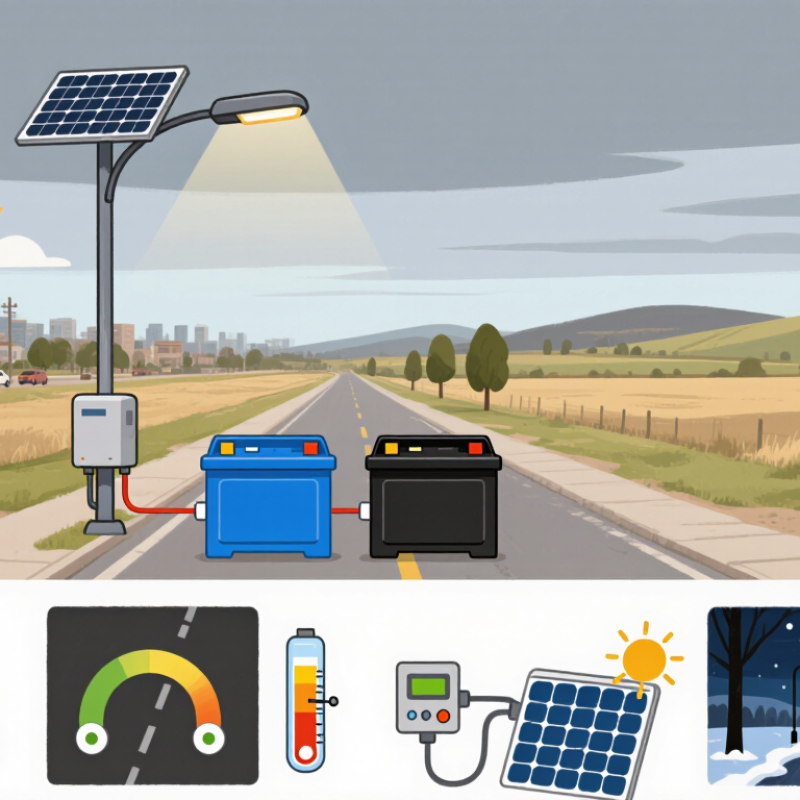
How to Estimate Solar Street Light Battery Life in 2026
Battery life depends on more than its advertised chemistry. The main factors are daily energy demand, usable capacity, temperature, charging control, and discharge depth. The U.S. Department of Energy Energy Storage Handbook lists typical cycle-life ranges of about 500–2,000 cycles for lead-acid batteries and 2,000–5,000 cycles for lithium-ion systems. These figures assume controlled conditions. Streets are less forgiving.
A practical estimate starts with nightly energy use. Include LED power, operating hours, controller losses, and cloudy-day reserve. A 40-watt lamp running for 12 hours needs roughly 480 watt-hours before system losses. Frequent deep discharges can shorten battery life, especially during winter. High heat also accelerates aging. The International Renewable Energy Agency reports that lithium-ion battery costs fell sharply over the past decade, but lower cost does not guarantee longer field life. Installation quality still matters. A loose connector can waste energy quietly.
Tips: Check the battery’s rated cycles at the actual discharge depth. Review local temperature records, not just annual averages. Keep panels unshaded at 4 p.m., when shadows are easy to miss. A neat spreadsheet can still lie. Real performance often differs from laboratory results. Leaving a 20–30% energy reserve is sensible, though site conditions may demand more.
Estimating solar street light battery life in 2026 starts with accurate field data. I record the battery’s voltage, rated capacity, chemistry, age, and usable depth of discharge. Label capacity can mislead. Measure it under a controlled load when possible. Battery temperature also matters, especially during cold nights. My first estimate ignored this factor and looked too optimistic.
For the solar panel, collect rated power, installation angle, shading hours, controller efficiency, and daily energy production. A temporary energy meter can reveal losses that specifications miss. One sunny day is not enough. Use several weeks of readings, including cloudy and rainy periods. Weather records should include solar radiation, cloud cover, rainfall, ambient temperature, and unusually long overcast conditions.
Measure the load after dusk, not only from its label. Record lamp wattage, operating hours, dimming levels, sensor behavior, and driver losses. A lamp marked 40 watts may consume less after midnight, but its controller can add a small standby draw. Compare daily energy generated with daily energy consumed, then apply battery temperature limits and discharge limits. Keep raw readings, dates, and measurement tools documented. If results conflict, inspect wiring and connections before changing the calculation. Do not hide uncertainty. A realistic estimate should show a range, such as four to six years, rather than one confident number.
| Site Profile | Average Peak Sun Hours (h/day) |
Solar Panel (W) |
Battery Chemistry | Battery Rating (V / Ah) |
Nominal Energy (kWh) |
Usable Depth of Discharge | Street-Light Load (W) |
Operating Time (h/night) |
Daily Energy Demand (kWh/day) |
Average Night Temperature (°C) |
Estimated Equivalent Full Cycles (cycles/year) |
Estimated Battery Life (years) |
|---|---|---|---|---|---|---|---|---|---|---|---|---|
| Coastal Temperate Road | 3.2 | 180 | LiFePO4 | 12.8 / 120 | 1.54 | 80% | 35 | 12 | 0.42 | 8 | 100 | 10–12 |
| Hot Arid Highway | 6.1 | 160 | LiFePO4 | 12.8 / 100 | 1.28 | 80% | 40 | 12 | 0.48 | 29 | 137 | 8–10 |
| Humid Tropical Village | 4.5 | 180 | LiFePO4 | 12.8 / 100 | 1.28 | 80% | 30 | 12 | 0.36 | 24 | 103 | 9–11 |
| Cold Continental Street | 3.0 | 200 | LiFePO4 | 12.8 / 150 | 1.92 | 80% | 45 | 13 | 0.59 | -5 | 140 | 7–9 |
| Low-Sun Mountain Pass | 2.4 | 220 | LiFePO4 | 12.8 / 150 | 1.92 | 80% | 30 | 12 | 0.36 | 4 | 103 | 9–11 |
| Moderate Urban Perimeter | 4.0 | 150 | Valve-Regulated Lead-Acid | 12 / 150 | 1.80 | 50% | 35 | 12 | 0.42 | 18 | 170 | 2–4 |
Start with the lamp’s real nightly energy use. A 40-watt LED operating for 12 hours consumes 480 watt-hours. Add controller losses, wiring loss, and battery charging loss. With a practical 85% overall efficiency, the required battery output becomes about 565 watt-hours nightly.
Dimming changes the result. For example, reducing power to 20 watts after midnight can cut consumption sharply.
Now estimate available solar charging power from local sunlight. The World Bank’s Global Solar Atlas provides monthly peak-sun-hour data for many locations. Multiply panel wattage by peak sun hours, then apply losses.
A 150-watt panel receiving 4.5 peak-sun-hours produces 675 watt-hours theoretically. Using the 14% default system-loss assumption in NREL’s PVWatts documentation leaves roughly 580 watt-hours. That is barely enough for the example load.
Battery sizing needs a reserve for cloudy weather. If the design requires three nights of autonomy, multiply 565 watt-hours by three. A 12-volt battery would need about 141 amp-hours before considering temperature, aging, and allowable depth of discharge.
Limiting usable depth to 80% increases the rated capacity to approximately 176 amp-hours. Battery life is not perfectly predictable. Cold nights, dust, shading, and weak charging can reduce performance faster than spreadsheets suggest.
Field measurements matter. Check morning voltage and charging current for several weeks, then revise the estimate. IEA PVPS reports continue to show strong photovoltaic deployment growth, but local weather still decides daily reliability.
Battery life begins with measured nighttime demand, not the battery label. Record lamp power, controller losses, and daily operating hours. A 40-watt lamp running 12 hours uses about 480 watt-hours before system losses. Add 15% to 25% for wiring, conversion, and cold-weather inefficiency. The estimate is imperfect. Dust, shade, and aging panels can change the result.
Divide usable battery energy by nightly load to estimate runtime. A 1,200-watt-hour battery may provide 960 watt-hours at an 80% depth of discharge. With a 552-watt-hour adjusted load, runtime is roughly 1.7 nights. In practice, plan for fewer dependable nights because reserve energy protects the battery. Test at 5°C and during the lowest expected sunlight, not only in a warm workshop. Log voltage before sunrise and compare it across several weeks.
Cycle life depends on depth of discharge, temperature, charging quality, and time spent fully charged. If the system uses 60% of capacity nightly, a battery rated for 3,000 cycles may theoretically last about 8.2 years. Field life can be shorter. Laboratory cycles are not a promise. Inspect capacity annually and consider replacement when usable energy falls near 70% of its original value. Record cloudy periods, low-voltage cutoffs, and unusual heat. These details often explain failure better than a spreadsheet.
How to Estimate Solar Street Light Battery Life in 2026
Adjust the Estimate for Temperature, Maintenance, and System Aging
A battery-life estimate should begin with measured field data, not only the datasheet. Record nightly energy use, battery capacity, discharge depth, and local weather conditions. A simple estimate divides usable battery capacity by nightly consumption. My first estimate was too optimistic because it ignored winter charging losses.
Temperature can change the result sharply. Many battery specifications use 25°C as the reference point. At lower temperatures, available capacity may fall, especially during long winter nights. High temperatures can accelerate chemical aging and shorten service life. Place the battery in a shaded, ventilated enclosure when possible. Also, avoid estimating from the daily average temperature alone. Battery temperature may remain high after sunset.
Maintenance affects both performance and evidence quality. Clean the solar panel when dust or bird deposits reduce output. Inspect cable connections for corrosion, looseness, or heat marks. Check charge-controller records every few months. For sealed batteries, do not add water or open the case. Measure nighttime voltage under load, because resting voltage can hide weakness. That matters.
System aging needs a reserve margin. Panel output can decline, battery capacity fades, and LEDs may consume more power after component changes. Recalculate the estimate annually using actual discharge data. A practical model may reduce expected capacity by a small percentage each year, then compare that figure with the required overnight reserve. The percentage is not universal. Local temperature, cycling depth, and maintenance quality can make the estimate wrong. Use conservative assumptions and document every adjustment.
Estimated service life for a LiFePO4 battery starting from an 8-year baseline at 25°C, one daily equivalent cycle, and proper maintenance. Temperature, maintenance quality, and normal system aging are applied sequentially.
The estimate is indicative rather than a guarantee. High operating temperatures accelerate battery degradation, while panel cleaning, correct charge settings, and timely inspections can help preserve usable capacity.
Record battery voltage, rated capacity, chemistry, age, temperature, and usable depth of discharge. Measure capacity under a controlled load when possible. Label capacity can mislead. Keep dates and raw readings.
Cold nights can reduce available energy and charging performance. Test around 5°C if that matches local conditions. My first estimate ignored temperature and looked too optimistic.
Record panel wattage, installation angle, shade hours, controller efficiency, and daily energy production. Use a temporary energy meter for several weeks. One sunny day is not enough.
Track sunlight, cloud cover, rainfall, ambient temperature, and extended overcast periods. A gray week can matter more than a bright afternoon. Weather records expose weak assumptions.
Multiply actual lamp wattage by operating hours. A 40-watt lamp running 12 hours uses 480 watt-hours. Add controller, wiring, and charging losses. Dimming changes everything.
Multiply panel wattage by local peak-sun hours. A 150-watt panel with 4.5 hours produces 675 watt-hours theoretically. After losses, output may fall near 580 watt-hours.
Multiply adjusted nightly demand by the required autonomy period. Three nights at 565 watt-hours requires 1,695 watt-hours of usable energy. Allow for temperature, aging, and discharge limits.
Divide usable battery energy by adjusted nightly load. A 1,200-watt-hour battery at 80% usable capacity provides about 960 watt-hours. With a 552-watt-hour load, runtime is roughly 1.7 nights.A battery’s laboratory cycle rating is not a promise. Check capacity annually and consider replacement near 70% of original usable energy. Keep inspecting.
Estimating solar street light battery life in 2026 requires more than checking the battery’s rated capacity. Start by evaluating battery chemistry, capacity, depth of discharge, charging efficiency, solar panel output, lighting power demand, operating hours, local sunlight, and weather conditions. Collect accurate data for the battery, panel, controller, LED load, and seasonal solar availability. Then calculate daily energy consumption and compare it with the energy the panel can realistically produce, allowing for system losses and cloudy periods.
Use these results to estimate how many hours the battery can power the light, how frequently it will complete charge and discharge cycles, and how those cycles affect service life. If you are asking “how long do solar street light batteries typically last,” the answer depends heavily on usage, climate, and battery quality, but a realistic estimate must also include temperature effects, regular maintenance, reduced panel performance, and gradual capacity loss as the system ages. Periodic testing and timely component adjustments can improve reliability and extend useful battery life.
